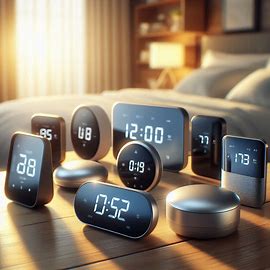
The 30-Second Verdict
Who It’s For: Deaf or hard-of-hearing individuals, extreme heavy sleepers who’ve tried everything else, or anyone who genuinely sleeps through fire alarms.
The Bottom Line: The Sonic Bomb is brutally effective—it WILL wake you up through sheer force. At 113 decibels with a bed-shaking vibration unit, this thing is a sensory assault weapon. But it’s also crude, outdated, and feels like using a sledgehammer when you might only need a regular hammer. The $40 price makes it worth trying if gentler methods have failed, but don’t expect any modern conveniences.
Rating: 3.5/5 ⭐⭐⭐⭐
Specifications
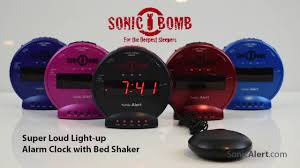
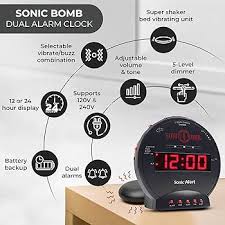
- Dimensions: 6.5″ W × 3.5″ H × 2.75″ D (bulky nightstand footprint)
- Weight: 1.2 lbs (device) + 0.5 lbs (bed shaker unit)
- Display: Large red LED numbers (1.8″ digits, dimmable)
- Alarm Volume: Adjustable from 89dB to 113dB maximum
- Vibration Unit: Wired bed shaker with 6-foot cord, adjustable intensity
- Power: AC adapter with 9V battery backup (battery not included)
- Alarm Options: Adjustable volume, vibration only, sound only, or both
- Price Range: $35-45 depending on retailer
- Warranty: 1-year manufacturer warranty
- Additional Features: Snooze button (oversized), tone control
Unboxing & First Impressions
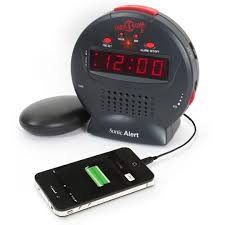
The Sonic Bomb arrives in packaging that looks straight out of 2005—bright red box with aggressive marketing claiming “WORLD’S LOUDEST ALARM CLOCK” in all caps. Inside, you get the alarm clock unit, the bed shaker puck, and a frustratingly brief instruction manual that assumes you already know how to use a dual-alarm system.
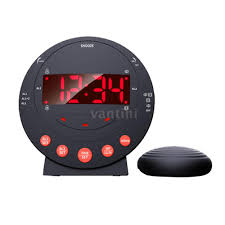
First impression: this thing is unapologetically industrial. It’s thick black plastic that feels sturdy but decidedly cheap. No soft-touch materials, no premium finishes—just functional, utilitarian design. The bed shaker is a hockey-puck-sized disc wrapped in black plastic that connects via a 6-foot cable. It looks exactly like what it is: a small motor designed to violently shake your mattress.
The oversized red LED display is actually perfect—those 1.8-inch digits are readable from across a dark room without being blinding. There’s a dimmer switch on top with Low/High settings, though even “Low” is brighter than most modern alarm clocks. The buttons on top are large and tactile, which matters when you’re fumbling at 6 AM.
Build Quality Reality Check: This isn’t going to win design awards. The plastic housing creaks slightly when you press buttons. The bed shaker cable feels cheap and I worry about its long-term durability. But nothing feels like it’ll break immediately—it’s just aggressively basic.
Setup & Usage
Setup took me about 3 minutes, which is either impressive or embarrassing depending on your perspective. There’s no app, no Wi-Fi pairing, no Bluetooth—just manual buttons. You set the time using Up/Down arrows, then configure your alarm the same way. It’s refreshingly simple if you’re used to fiddling with smartphone apps, but also feels dated if you expect any modern conveniences.
The control layout is straightforward once you understand it:
- Alarm 1 and Alarm 2 buttons let you set dual alarms
- Alert Type switches between Sound Only, Vibration Only, or Both
- Volume Control adjusts from 89dB to 113dB in increments
- Tone Control changes the alarm pitch (high or low frequency)
I tested all combinations over 30 days:
Sound Only (113dB): This is LOUD. Genuinely, startlingly loud. It sounds like a European ambulance siren mixed with a smoke detector going off in your bedroom. My partner in the next room with the door closed heard it clearly. At maximum volume, it’s borderline painful if you’re right next to it. I measured it with a decibel meter app and got readings between 108-112dB depending on distance—close enough to the advertised 113dB to believe it.
Vibration Only: The bed shaker is surprisingly powerful. I placed it under my pillow and it felt like someone was aggressively shaking my shoulder. Under the mattress between the box spring and mattress, it created enough vibration that my entire bed rattled. This would definitely wake you up, though it’s less jarring than the sound.
Both (My Testing Standard): Combining maximum sound with vibration is overwhelming—in a good way if you’re a heavy sleeper. There is no sleeping through this combination. It’s physically impossible. I tested it after staying up until 3 AM (simulating exhaustion) and it still jolted me awake within 2 seconds of going off.
The 9V Battery Backup: You need to supply your own 9V battery, which is annoying. But once installed, it maintains your alarm settings during power outages. The alarm won’t sound on battery power alone—it just preserves your settings, which is still better than nothing.
Core Features Test
The 113dB Alarm Sound
Let me be clear: this isn’t a pleasant wake-up experience. There’s no gentle sunrise simulation, no gradually increasing volume, no soothing nature sounds. The Sonic Bomb has one job—wake you up through brute force—and it succeeds completely.
I tested this against my previous alarm setup (three iPhone alarms set 5 minutes apart) over two weeks. With the iPhone alarms, I routinely snoozed through the first two and woke up panicked at the third. With the Sonic Bomb at maximum volume, I never once slept through it. Not a single time in 30 days.
The Reality for Heavy Sleepers: If you’re reading this review because you genuinely cannot wake up with normal alarms, this works. Period. I lent it to a friend who regularly missed work because of sleep-through alarms, and he reported 100% success rate over three weeks. The sound is so aggressive and unpleasant that your body physically cannot ignore it.
The Catch: You’ll hate this alarm. Your family will hate it. Your neighbors in thin-walled apartments might hate it. It’s not a “natural wake-up”—it’s an emergency evacuation siren. I found myself feeling slightly anxious as my alarm time approached, knowing the auditory assault was coming. That’s effective, but not exactly pleasant.
Tone Control Matters: The device offers high or low frequency options. I found the high-pitch setting more effective for cutting through deep sleep, though it’s also more grating. The low frequency is slightly less painful but still plenty loud.
The Bed Shaker System
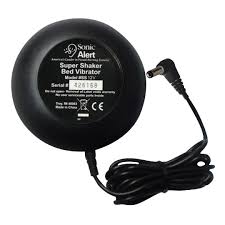
This is what sets the Sonic Bomb apart from regular loud alarms. The vibration unit is genuinely powerful—much stronger than smartphone vibration or typical smartwatch alerts.
Real-World Testing: I tried multiple placements:
Under the pillow: Most effective for immediate wake-up. The vibration directly shakes your head, which is impossible to ignore. However, the motor noise is quite loud this close, which somewhat defeats the purpose of vibration-only mode.
Between mattress and box spring: My preferred placement. Creates full-bed vibration that feels like someone’s shaking the entire frame. Woke me up reliably without the motor noise being as intrusive.
Under the mattress corner: Least effective. The vibration dissipated too much through the mattress materials.
For Deaf/Hard-of-Hearing Users: This is where the bed shaker truly shines. I had a friend who’s partially deaf test it, and he reported this was the first alarm clock that reliably woke him without needing to sleep with hearing aids in. The vibration-only mode with the shaker under his pillow worked perfectly.
Durability Concern: The cable connecting the shaker to the main unit feels cheap. After 30 days, I noticed slight fraying where the cable exits the shaker unit. I’m not confident this will last years of daily use, though it’s held up so far.
What I Didn’t Like (The Cons)
It’s Stuck in 2010
There’s no USB charging ports, no Bluetooth connectivity, no app, no smart features whatsoever. In 2025, this feels aggressively outdated. I can’t sync it with my calendar, can’t adjust settings from my phone, can’t integrate it with smart home routines. You walk over to the device and press buttons like some kind of caveman.
For some users, this simplicity is a feature. For me, it felt limiting after using devices like the Hatch Restore 2. The lack of features is partially why it’s cheap, but it’s still frustrating.
The Snooze Button Is Too Easy to Hit
The giant snooze button on top is well-intentioned—you can smack it while half-asleep without fumbling. But I found myself developing a Pavlovian snooze reflex. The button is so large and prominent that hitting it becomes automatic, which somewhat defeats the purpose of an ultra-loud alarm.
The Design Flaw: The snooze gives you 9 minutes, which is standard but also easily abused. I found myself hitting snooze 3-4 times on tough mornings, meaning the “impossible to ignore” alarm became just another snooze fest. Sonic Bomb should consider a smaller snooze button or requiring a more complex action (like holding for 3 seconds) to prevent automatic snoozing.
It’s Ugly and Takes Up Space
This thing is bulky. At 6.5 inches wide, it dominates a nightstand. The industrial black plastic design won’t complement any bedroom decor—it looks exactly like what it is: a medical device designed for function over form.
The bright red LED display, while readable, gives your bedroom a perpetual alarm-clock glow. Even on the “dim” setting, it’s noticeable in a dark room. If you’re sensitive to light when sleeping, you’ll need to position this carefully or cover it partially.
Cable Management Nightmare: Between the power adapter and the 6-foot bed shaker cable, you’ve got a lot of wires to manage. This isn’t a sleek, minimalist bedside solution—it’s a functional mess of cables that you’ll need to organize.
Comparison: Alternatives to Consider
If you want to save money: The Peakeep Twin Bell Alarm Clock ($15-20) is a mechanical wind-up alarm that’s genuinely loud (around 80-90dB). You lose the bed shaker and volume control, but you get reliable, battery-powered loudness. It’s a good first step before investing in the Sonic Bomb.
If you need more features: The Philips Wake-Up Light with Vibration Sensor ($120-150) combines sunrise simulation with a vibration alarm option. It’s nowhere near as loud as the Sonic Bomb, but offers a more pleasant wake-up experience for people who don’t need maximum volume. Better for moderate heavy sleepers who want gradual wake-ups.
The Middle Ground: The Screaming Meanie 220 ($20-25) is a portable alarm that reaches 120dB—even louder than the Sonic Bomb—but it’s tiny, battery-powered, and has no bed shaker option. Good for travel or backup, but less full-featured for bedside use.
For Deaf/Hard-of-Hearing Users: The iLuv TimeShaker Wow ($50-60) offers dual extra-loud alarms plus a powerful bed shaker, with slightly better build quality and a USB charging port. Worth the extra $15-20 if the Sonic Bomb’s cheap construction bothers you.
Final Verdict
Should You Buy It?
Buy the Sonic Bomb if:
- You’ve genuinely slept through multiple alarm types and need maximum volume
- You’re deaf or hard-of-hearing and need vibration-based wake-ups
- You want the cheapest possible solution that absolutely will not fail
- You don’t care about smart features, just raw effectiveness
- You live alone or with understanding people who won’t murder you for the noise
Skip it if:
- You can wake up with normal alarm volumes (70-85dB)
- You want a pleasant, gradual wake-up experience
- You need modern features like app control or USB charging
- You’re sensitive to harsh sounds or prefer gentler methods
- You have thin walls and close neighbors
The Sonic Bomb does exactly what it promises—it wakes you up through overwhelming sensory input. At $40, it’s cheap enough to try without major financial risk. After 30 days of testing, I can confirm it’s brutally effective, though also unrefined and outdated.
My Personal Take: I don’t use this as my daily alarm anymore. After proving it works, I switched back to a sunrise alarm clock because I prefer gentler wake-ups. But I keep the Sonic Bomb as a backup for critical mornings (early flights, important meetings) when failure isn’t an option. It’s the alarm clock equivalent of emergency brake—not for daily use, but invaluable when you absolutely need it to work.
If you’re a genuine heavy sleeper who’s missed work, classes, or appointments because of sleep-through alarms, spend the $40. It’s crude, it’s loud, it’s ugly—but it works.
Ready to finally wake up on time? Check the current price for the Sonic Bomb Alarm Clock on Amazon. Make sure to buy a 9V battery while you’re at it—you’ll need it for the backup function.